
Phygital services - a Deutsche Bahn experience
Thoughts on how digital services made traveling with DB bearable for me.

To be honest, Pokémon was never really my thing. But in 2016 I did take notice of Pokémon Go. This was an augmented reality app to catch Pokémons and thus got many people out of the comfort of the living room into to irl spaces: squares, parks, McDonald's [1] and, well other people's backyard (gotta catch 'em all!). As Shoshana Zuboff notes, Pokémon Go "proved that surveillance capitalism could operate in the real world as much as it does in the virtual one". [2]
Pokémon Go might have marked one of the early examples of the digital realm mixing with the meat space. This was followed by the likes of scooter sharing, shopping, car pooling and other apps whose value arise not only from what's on the screen, i.e. the digital space, but also from users doing something in the physical space as well. Hence the expression phygital experiences.
Phygital experiences can be straightforward: you catch a Pokémon; scan your loyalty QR code at checkout; ride a few miles with a scooter. Cool, but what if there is a physical system that is utterly complex? How does phygital fare there? Well, let me kindly introduce you to Deutsche Bahn (or DB for short).
The physical DB
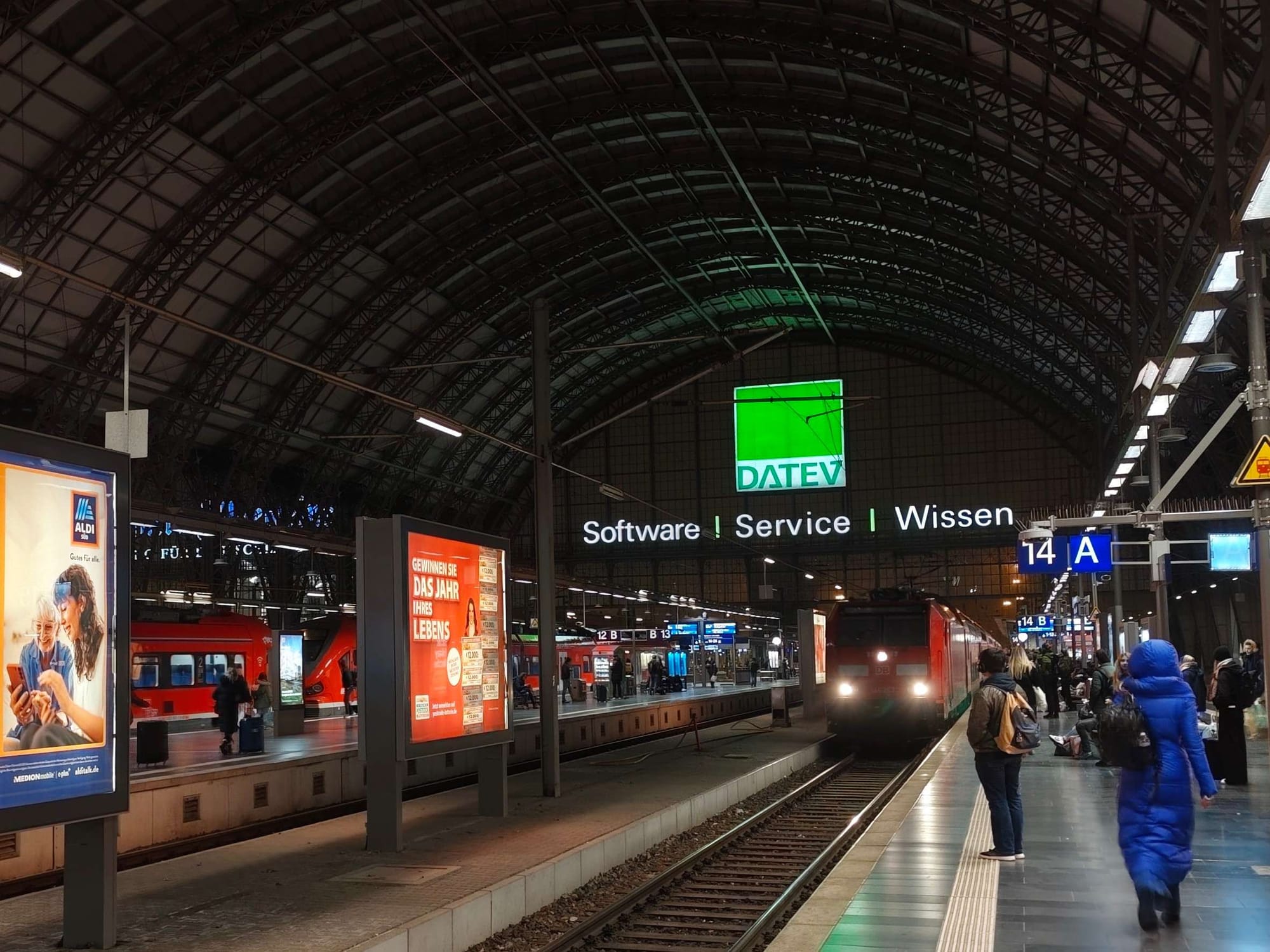
Deutsche Bahn is facing some grave challenges. This fall I spent only three days traveling by train in Germany but that was enough to experience one train cancellation, two changes of platforms and several delays. This gave me a pause, despite being pretty accoustmed to delays at MÁV, the Hungarian railway company.
A thorough analysis of how severe the situation at Deutsche Bahn is not the point here. Suffice to say, delays have a separate heading on the Wikipedia page, it's a running meme and there is even a song about it.
But here is the interesting thing:
my experience with DB as a whole was not as bad as the physical reality described above would imply. And this is mainly due to the flexibility offered by the Deutschland Ticket and the DB Navigator app.
The digital DB
Deutschland Ticket is basically a pass which for a fixed monthly fee, allows you to travel by public transport anytime and anywhere in Germany. This is probably to promote public transport. Cool, but as a side effect it also allowed me to not worry about getting a refund and buying new tickets in case of train delays. Thus having a Deutschland Ticket freed me of worry and allowed for flexibility.
Flexibility is only achieved if you know what's going on and what your alternatives are. In other words, to catch Pokémons, you need a way to find them. That's where the DB app comes into play.
The app for DB is aptly named DB Navigator, because a main feature of it is to plan routes and provide timely updates about e.g. delays and change of platforms. And the app does this in a pretty okay way.
The UI looks good, it's speedy and it has dark mode. The route planner has a nice addition where you can configure the time needed for transfers, which is handy when trains are not always on time. And when a train is on time, delayed, or cancelled, this information is presented in the app with appropiate green / red colour-coding.
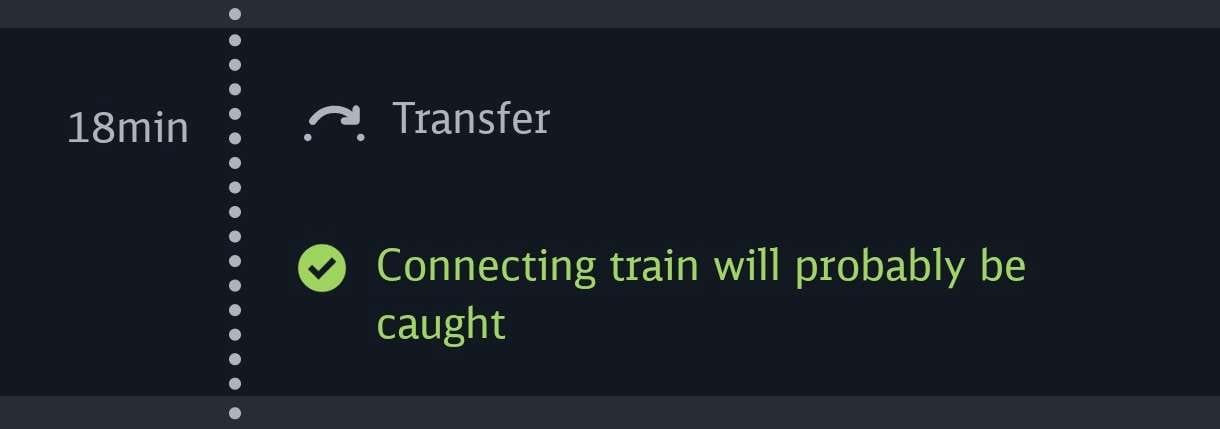
So the effect of the physical reality of DB was somewhat dampened by the flexibility provided by the Deutschland ticket and the good UX of the DB app, which resulted in an okayish phygital experience for me.
The phygital DB
So can digital solutions mitigate the shortcomings of physical services? In the case of DB, I would say yes and no.
Yes, because by using the DB app I was informed and could adapt to changes all backed by the flexibility of the Deutschland Ticket.
No, because I still lost time, some level of uncertainty remained and had to spend a good amount of my traveling time fidgeting with DB Navigator.
This last bit, i.e. catching trains (instead of Pokémons), left me with an uneasy feeling. Is it really the way I want to travel? Do I want to have a constant itch to check an app when I'm supposed to be just sitting and traveling? Yes, the app looks nice and it's basically gamifying the traveling experience. But thanks, maybe I would like to keep gaming and traveling separate.
A note on phygital services
A logical takeaway from my DB experience would be that good digital services can only sugarcoat the shortcomings of physical ones. To a certain extent, this may be true. At least in the case of railways no digital app can beat punctual trains for sure.
Physical and digital spaces coexist and while great UX in one cannot totally override subpar UX in the other it seems like a missed opportunity not to treat them as being part of the same user journeys and search for synergies. It may follow that great phygital experiences might hinge on sg. that could be called phygital service design.
This kind of service design could take into account the unique combinations of physical events and digital affordances. For example, with up-to-date information about train delays it could be possible to calculate ad-hoc travel plans that take train delays into account. So the user is not only informed but can easily act upon that information.
In Hungary it is the case that a traveler cannot buy a ticket for a delayed train right before boarding. A workaround exists, but it works by having to buy a ticket well in advance. It would be more elegant to be able to just buy a ticket at the time of boarding. But for now the traveler might be better of playing Pokémon Go while waiting for the other delayed train, and then catch that as well.
References
[1] Shoshana Zuboff: The Age of Surveillance Capitalism, 2019, Profile Books, London. p. 315
[2] Zuboff p. 316
Bármilyen kérdést, észrevételt szívesen várok az [email protected] címre [beta verzió - a válaszüzenet lehetséges, hogy a spam mappába kerül], vagy más kapcsolattartási módon keresztül.
A digitális tudatossághoz kapcsolódó forrásokat itt találsz.
A bejegyzés elkészítéséhez szükséges idő: 10h
Est. GSS: 7